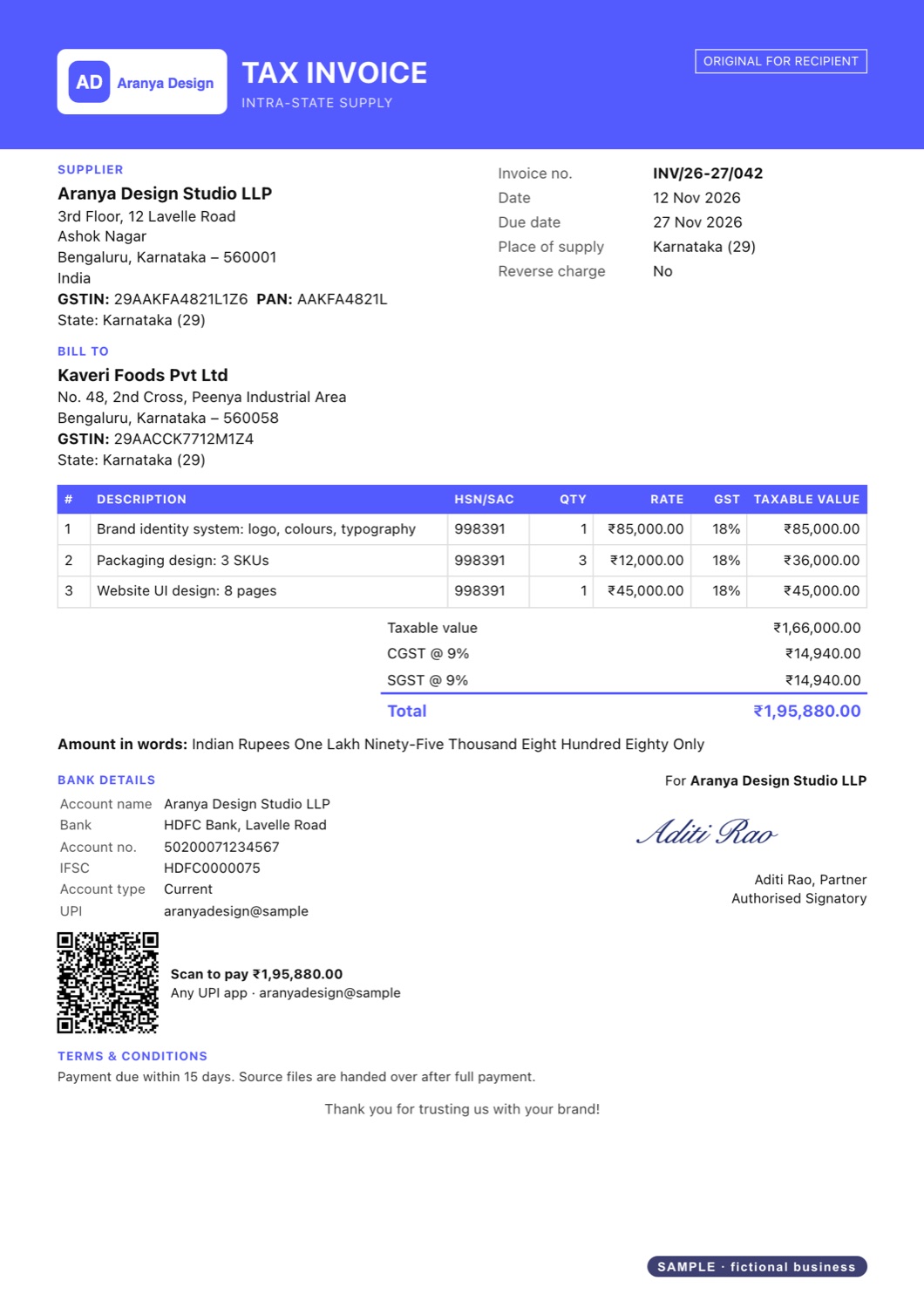
Mandatory fields on a GST tax invoice
Rule 46 of the CGST Rules lists what a tax invoice must contain. In plain words:
- Your details: name, address and GSTIN.
- Invoice number: up to 16 characters, consecutive and unique within the financial year. Letters, numbers, hyphens (-) and slashes (/) are allowed, for example INV/25-26/001.
- Invoice date.
- Customer details: name, address and GSTIN if they're registered.
- For an unregistered customer with an invoice of ₹50,000 or more: their name and address, the delivery address, and the state name and code.
- HSN code for goods or SAC code for services.
- Description of the goods or services.
- Quantity and unit for goods, such as Nos, Kg or Metre.
- Total value and the taxable value after any discount.
- Tax rate and amount for each tax: CGST, SGST or UTGST, or IGST, and cess if any.
- Place of supply with the state name, for supplies to another state.
- Delivery address, if different from the place of supply.
- Whether tax is payable on reverse charge.
- Signature or digital signature of you or someone you authorise. E-invoices don't need one.
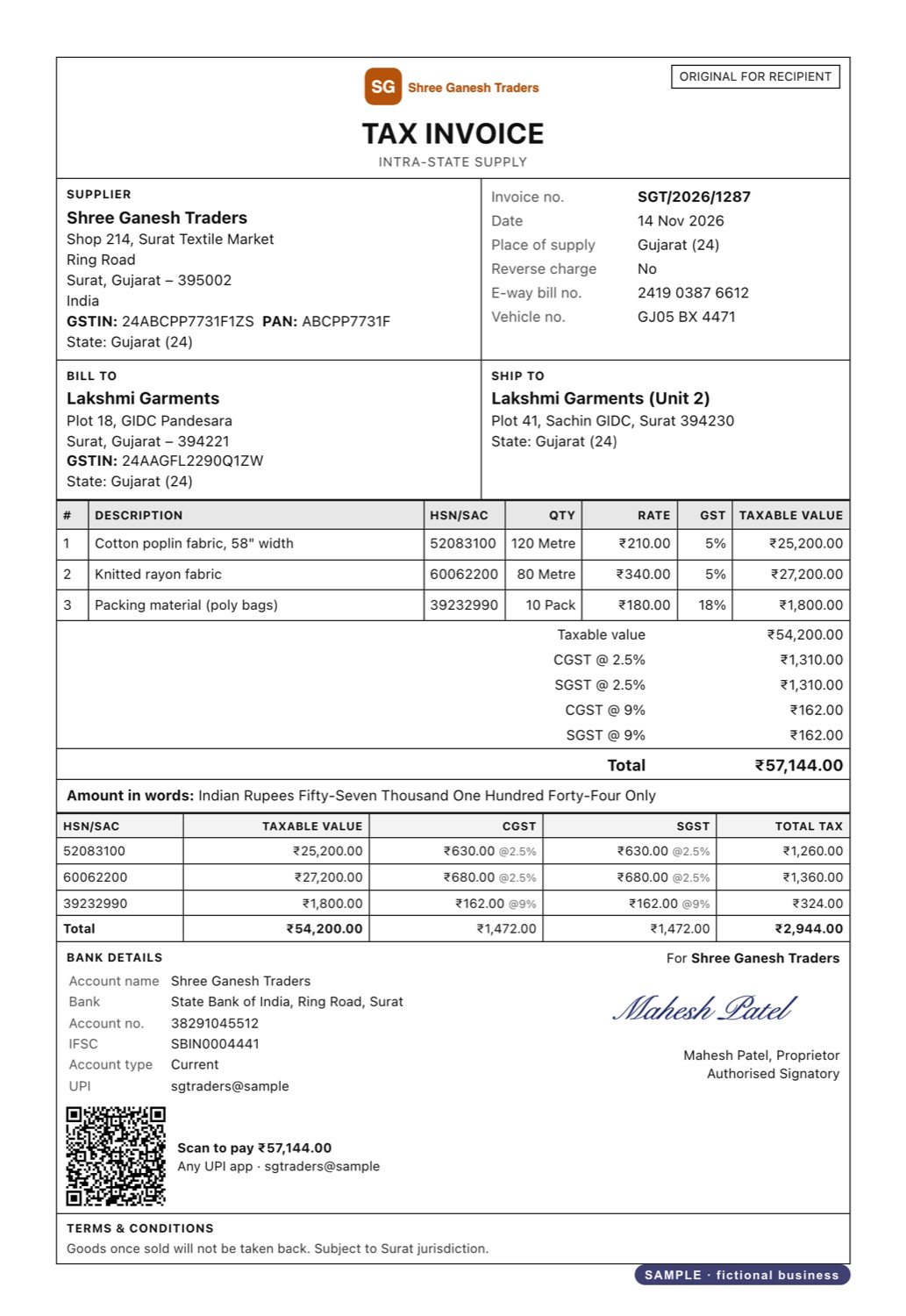
How many HSN digits do you need?
| Turnover last financial year | HSN or SAC digits |
|---|---|
| Up to ₹5 crore | 4 digits on B2B invoices |
| Above ₹5 crore | 6 digits on all invoices |
When to issue it, and how many copies
- Services: within 30 days of providing the service.
- Goods: when the goods are removed or delivered.
- Copies for goods: three. The original for the buyer, the duplicate for the transporter, and the triplicate for you.
- Copies for services: two. The original for the client and the duplicate for you.
Do you need an e-invoice?
If your aggregate turnover crossed ₹5 crore in any financial year since 2017-18, B2B invoices and exports must be reported to the government's Invoice Registration Portal, which returns an IRN and a signed QR code to print on the invoice. Businesses with turnover of ₹10 crore or more must report each invoice within 30 days of its date. Below ₹5 crore, a regular invoice like the ones on this page is enough.
Common mistakes
- Charging IGST on a sale within your state, or CGST + SGST on a sale to another state. It depends on the place of supply, not where you are.
- Restarting invoice numbers mid-year, or reusing a number. Numbers restart only at the start of a financial year.
- Deleting a wrong invoice. Issue a credit note instead.
- Missing the customer's GSTIN, which stops them claiming input tax credit.