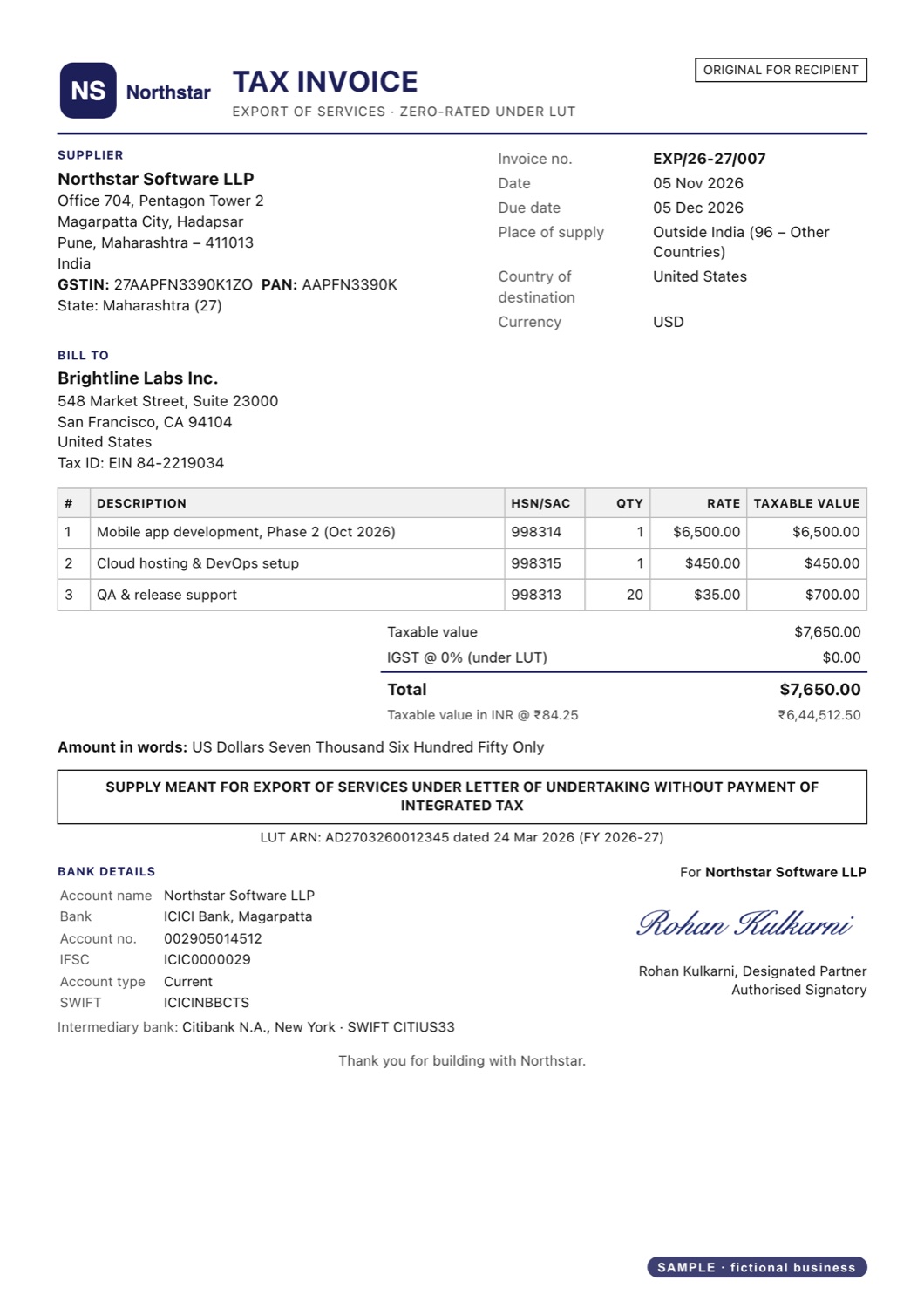
What an export invoice must show
An export invoice is a tax invoice, so it needs the usual Rule 46 fields (see the GST invoice format). On top of that:
- The export declaration, in one of these forms:
- “SUPPLY MEANT FOR EXPORT UNDER BOND OR LETTER OF UNDERTAKING WITHOUT PAYMENT OF INTEGRATED TAX”, or
- “SUPPLY MEANT FOR EXPORT ON PAYMENT OF INTEGRATED TAX” if you pay IGST and claim a refund.
- Your customer's name and address abroad, the delivery address, and the country of destination.
- Your LUT ARN and the financial year it covers. It isn't a listed field, but it's standard practice and helps your CA.
- The amount in the foreign currency, and its value in rupees. You report the INR value in GSTR-1.
- For goods, the shipping bill number and date, and the port code, once you have them.
What a Letter of Undertaking (LUT) is
An LUT lets you export without paying IGST up front. You file it online on the GST portal in form RFD-11, once for each financial year, before you invoice. It's free and usually approved immediately. Without an LUT you pay IGST on the export and claim it back as a refund, which ties up cash.
When services count as exports
Services are “exported” (and zero-rated) only if all of these are true:
- You're in India.
- Your client is outside India.
- The place of supply is outside India.
- You're paid in convertible foreign exchange, or in rupees where the RBI allows it.
- You and your client aren't just two offices of the same business.
Under an LUT, payment for exported services must arrive within one year of the invoice date, and for goods the goods must leave India within three months. Otherwise you pay the IGST with interest. Your bank's FIRC or e-BRC is your proof of payment.